Lasting Transformation doesn't happen at the surface level.
It happens when we work at the right level of thinking.
Robert Dilts developed the “Logical Levels” framework to help individuals and organisations understand how change happens. Each level represents a different layer of human experience, belief, and behaviour. When leaders understand these levels, they stop firefighting and start leading with clarity, alignment, and purpose.
So what Are Dilts’ Logical Levels?
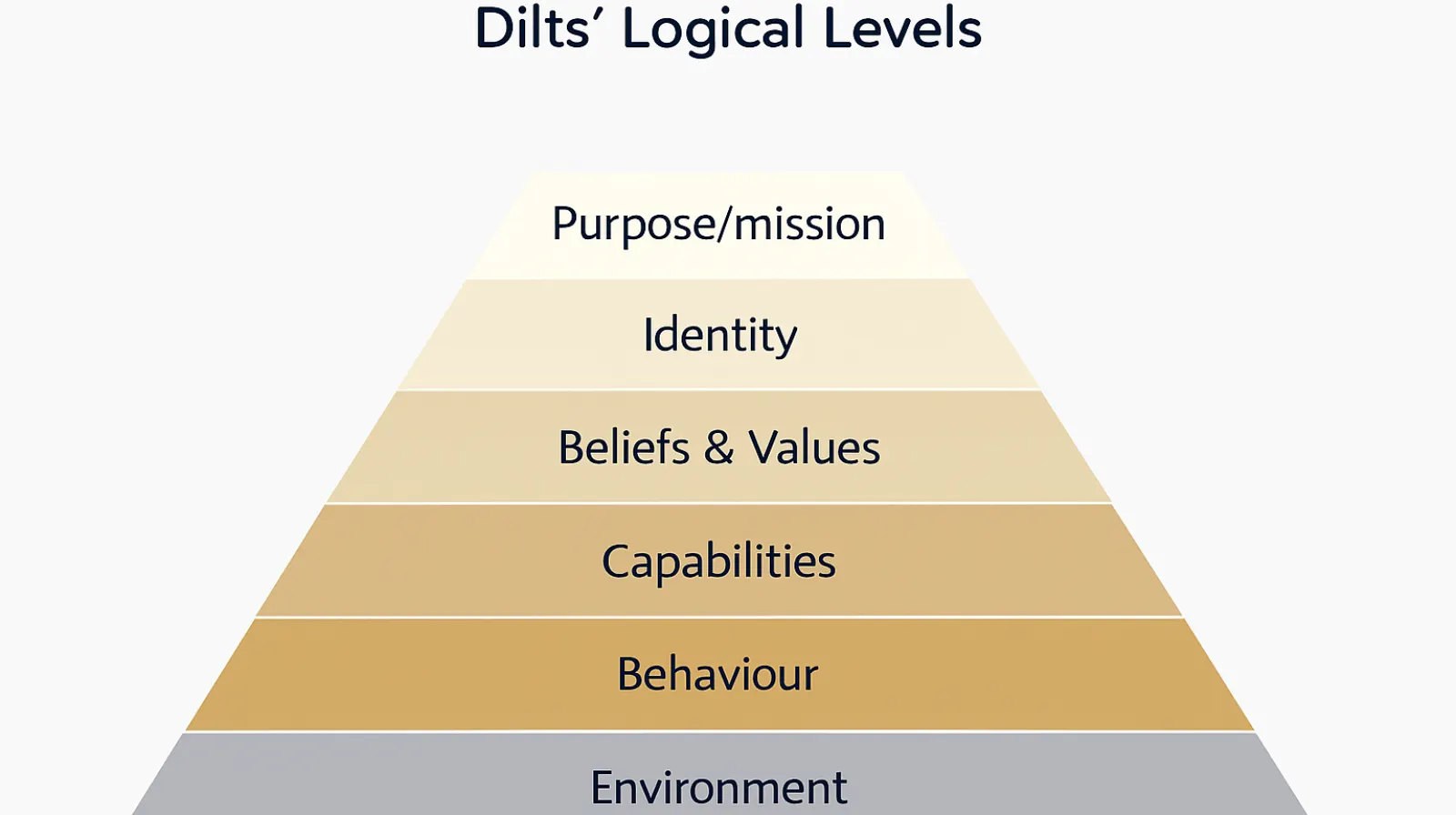
The six levels are:
# Environment – Where you operate
# Behaviour – What you do
# Capabilities – How you do it
# Beliefs & Values – Why you do it
# Identity – Who you are
# Purpose / Mission – For whom or for what greater cause
These levels are hierarchical — change at a higher level influences all levels below it.
Education leadership is uniquely complex. You are expected to:
# Drive improvement with limited resources
# Lead through uncertainty and political pressure
# Elevate staff wellbeing while managing performance
# Build cultures of excellence that outlast you
# Stay values-driven in a system that often pulls you off course
The Logical Levels help leaders break through overwhelm because they:
✔ Diagnose issues more accurately - Many leaders try to solve Identity-level problems with Behaviour-level solutions — and wonder why nothing sticks.
✔ Drive deeper, sustainable change - Shifting beliefs or identity can transform entire teams, not just individual tasks.
✔ Align staff, strategy, and culture - When values, identity, and purpose are aligned, performance increases exponentially.
✔ Strengthen leadership resilience - Leaders anchored in purpose can navigate crisis without losing themselves.
A Practical Walkthrough: Using Logical Levels in Coaching
Let’s apply the model to a real education leadership scenario:
A senior leader feels “stuck”, overwhelmed by constant change demands and struggling to motivate their team.
Environment - What’s happening around them? Budget cuts, accountability pressures, increased workload.
Behaviour - What are they doing? Working longer hours, avoiding delegation, delaying decisions.
Capabilities - What skills do they need? Delegation frameworks, prioritisation, confident communication.
Beliefs & Values - What’s driving their choices? “I must protect my team from pressure.” “If I delegate, I’m adding to others’ stress.”
Identity - Who do they believe they are? “I’m the person who holds everything together.”
Purpose / Mission - What are they ultimately serving? Creating stability and excellence for pupils and staff.
Insight: The issue isn’t the workload. It’s the belief that leadership means self-sacrifice — an identity-level pattern that keeps them trapped.
Coaching at the right level unlocks transformation.
How Leaders Can Use the Logical Levels to Elevate Their Leadership?
Here are powerful self-coaching prompts you can use or share with your team:
1. Environment - What in your environment supports you? What drains or distracts you?
2. Behaviour - What actions are moving you forward? What habits keep you stuck?
3. Capabilities - What strengths can you leverage? What skills would make the biggest difference right now?
4. Beliefs & Values - What do you believe about yourself as a leader? Which beliefs serve you — and which limit you?
5. Identity - Who are you at your best as a leader? What identity do you want to grow into?
6. Purpose - Why does this work matter to you? What legacy do you want to leave?
When leaders reflect at all levels, decisions become clearer, alignment strengthens, and performance lifts without burnout.
Why This Model Is Transformational in Organisations:
For Teams - It helps diagnose conflict, misalignment, or low morale. Often, you’ll find the issue sits at Values or Identity — not capability.
For Culture - It offers a blueprint for creating high-performing, psychologically safe environments.
For Change Management - It reduces resistance by ensuring change addresses the right level.
For Wellbeing and Retention - When staff connect their identity and purpose to the work, burnout reduces dramatically.
How I Use Dilts’ Logical Levels in Executive & Education Leadership Coaching
In my coaching approach, I use the Logical Levels to help leaders:
# Reconnect with their deepest purpose
# Clarify their leadership identity
# Shift unhelpful beliefs that block progress
# Build strategic capabilities with confidence
# Create behaviours and habits that sustain high performance
# Rebuild balance, energy, and professional fulfilment
The result? A grounded, confident leader who leads with intention — not overwhelm.
If you want to explore this powerful model in more depth, or apply it to your own leadership challenges, I’d love to support you.
Ready to Lead at a Higher Level?
If you’re an education leader or executive who is ready to:
# Lead with clarity
# Strengthen your identity as a leader
# Unlock deeper confidence
# Align your team and culture
# Drive change without burning out
…then Dilts’ Logical Levels can be a game-changer for you.
Book a coaching consultation today to explore how this framework can transform your leadership.